


In the July edition of BusinessIT magazine, I shared some reflections on the importance of digital accessibility and the challenges that Portugal still faces in this area. You can read the full article in portuguese here.
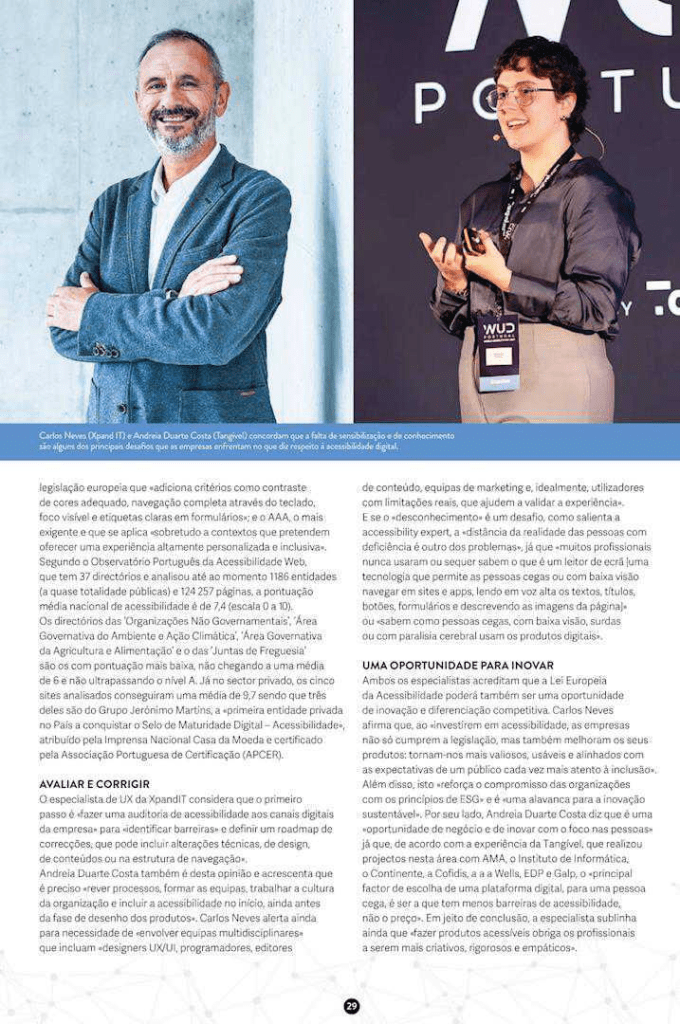
In this blog post, I revisit the same topic to further explore and expand on ideas I initially shared, drawing not only from various sources but also from my daily experiences as an Accessibility Lead at Tangivel.
A different reality between the public and private sectors
Portugal has made some progress in the area of accessibility, but there’s still a long way to go, both in the public and private sectors. Many digital services and platforms still have barriers that make it difficult or even impossible for people with disabilities to access them.
The public sector has made more noticeable progress, largely due to legislation introduced as early as 1999, which has helped establish internal processes and build teams that are now more aware of the importance of accessibility. The AMA (Agency for Administrative Modernization) has played a key role in promoting and monitoring accessibility in government digital services and has introduced the Accessibility and Usability Seals to support this effort.
The private sector, however, presents a more challenging scenario. Digital accessibility is still not a priority for many companies. There are some exceptions, such as banks or companies with an international presence, which are required to comply with stricter regulations in other markets. However, many businesses still struggle, whether due to a lack of awareness, limited technical knowledge, or because accessibility is not integrated into their business strategy. Accessibility is often seen as a cost rather than an investment, which leads to it being delayed or pushed aside. The introduction of the European Accessibility Act on June 28 is shifting this perspective, as it compels private companies to consider the accessibility of their products and the potential legal consequences of non-compliance.
Businesses need to start working on accessibility somewhere
Many companies will need support to adapt quickly. Preparing isn’t just about ensuring products meet minimum requirements. It means reviewing processes, training teams, working on organizational culture, and including accessibility from the very start, even before the product design phase.
Since many websites and apps are already on the market with established processes, we believe the first step is to understand the current state of the product’s accessibility, for example, through an audit. From there, a plan can be defined with priorities, budget, and a continuous effort to improve accessibility. This involves training teams, but also engaging people with disabilities in the process, including them from the research phase, through interviews or usability testing.
Companies and their teams face some challenges
One of the biggest challenges is the lack of awareness and the disconnect from the lived experiences of people with disabilities.
The reality is that many design, development, and product teams have never used a screen reader or a magnification tool. They often have no idea how a blind, deaf, low vision person, or someone with cerebral palsy navigates a website or app. Without that firsthand understanding, it’s difficult to design truly accessible digital experiences.
Take screen readers, for instance, they turn visual content into audio, allowing users to hear text, headings, image descriptions, and button labels. But for that to work well, websites need to be properly designed and coded, with clear logic and properly described elements. Too often, that’s not the case, usually due to lack of awareness, limited time, or simple oversight.
The European Accessibility Act can be an opportunity for innovation and competitive differentiation
Accessibility is not just a legal obligation, it is a business opportunity and a chance to innovate with a focus on people.
Blind people, those with low vision, deaf individuals, people with cerebral palsy, among others, are also customers. They have purchasing power, recommend products and services to their families and friends, and prefer inclusive brands, yet they continue to be ignored in data analysis and decision making processes. A blind person will choose the bank with fewer barriers that allows them to carry out transactions independently, not necessarily the cheapest bank.
Furthermore, a common myth is that accessibility “ruins” design or limits creativity, which is not true. Creating accessible products forces us to be more creative, rigorous, and empathetic. Another myth is thinking that accessibility is only for people with vision problems, but in reality, we all benefit from accessible products, including people with autism, someone with a broken arm, or even an 80-year-old person using their smartphone.
 andreia duarte costa
Leave a comment